Facial Balancing Boston
Personalized Facial Balancing Designed Around Your Anatomy
Facial balancing is not about changing every feature or adding volume everywhere. At AeLeeMD in Boston, we evaluate the face as a whole—considering facial structure, proportion, projection, profile, and the relationship between individual features.
Each treatment plan is customized around your anatomy and aesthetic goals, with an emphasis on natural-looking refinement and overall facial harmony.


What Is Facial Balancing?
Facial balancing is a whole-face approach to aesthetic treatment. Rather than evaluating the nose, lips, chin, cheeks, or jawline in isolation, the face is assessed as one interconnected structure.
Small, strategic adjustments in the right areas can influence how the entire face is perceived—sometimes without dramatically changing any single feature.
Our Approach to Facial Balancing
Before deciding what to treat, we evaluate how your features work together—from facial proportions and central projection to profile balance, structural support, and natural expression.
01 FACIAL PROPORTIONS
Upper Face · Midface · Lower Face
We assess the relationship between the upper, middle, and lower face to understand where proportion may feel visually unbalanced.
02 Central Projection
Brow · Nose · Midface · Chin
We evaluate how the brow, nose, midface, and chin create forward projection and three-dimensional facial structure.
03 Profile Balance
Nose · Lips · Chin · Jawline
From the side, we consider the relationship between the nose, lips, chin, and jawline—not just one feature in isolation.
04 Facial Support
Structure · Support · Contour
We look at underlying structural support and facial transitions to understand how they influence contour, proportion, and overall harmony.
05 Dynamic Expression
Smile · Movement · Expression
A balanced face should still look natural in motion. We consider how your features move when you smile, speak, and express emotion.

Asian Facial Balancing
Facial balancing is never one-size-fits-all. Asian facial anatomy can present different relationships between facial width, central projection, midface structure, nose, lips, and chin—making individualized assessment especially important.
At AeLeeMD, we focus on how these features work together rather than applying a single aesthetic template. Treatment planning may consider central facial projection, three-dimensional structure, profile balance, and the relationship between the inner and outer facial contours.
Our goal is not to Westernize the face or erase ethnic characteristics. It is to refine proportion and structure while preserving the features that make each person recognizable as themselves.


What Areas Can Be Treated?
Areas We May Consider in a Facial Balancing Plan
Every facial balancing plan is different. Depending on your anatomy and goals, treatment may focus on one area or a carefully selected combination of areas.
Nose:Central projection and profile balance.
Chin:Lower-face proportion and structural support.
Lips & Perioral Area:Lip proportion and balance with surrounding facial features.
Midface & Cheeks: Structural support and smoother facial transitions.
Nasolabial Area:Assessment of the structural factors contributing to visible folds.
Jawline:Lower-face definition and overall facial proportion.


Why Choose AeLeeMD for Facial Balancing in Boston?
At AeLeeMD, facial balancing begins with understanding the face before selecting a product or treatment area.
We consider how each adjustment may affect surrounding features, facial proportions, profile, movement, and long-term balance. Our approach is individualized, conservative, and designed around each patient's anatomy and aesthetic goals.
We do not aim to create the same face on every patient. The goal is to preserve identity while creating a more refined and harmonious version of what is already there.
Boston Facial Balancing Before & After
Facial balancing looks different on every face. The treatment plan depends on what is creating the visual imbalance—not simply which feature appears too large, too small, or too flat.

The nose, lips, chin, and jawline are evaluated as one profile rather than separate features. Small structural adjustments can create a more harmonious side profile without making any single feature look overtreated.

Chin, lips, and surrounding structures can influence how the entire lower face is perceived. Treatment focuses on proportion and transition rather than simply adding volume.

Prominent cheekbones are not always a cheekbone problem. When central projection is limited, the lateral cheekbones become more visually dominant. Improving facial balance and surrounding transitions can help the cheekbones appear more proportionate within the face.

In this case, the after profile shows stronger central projection, improved nose-to-chin balance, and a more defined transition through the lower face. The result is a more structured and harmonious side profile while preserving the patient’s natural masculine features.
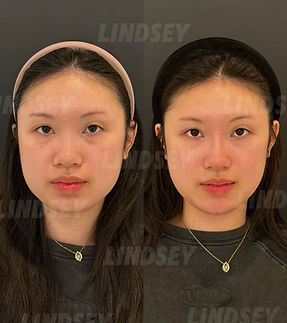
A face can sometimes appear wider when central projection is limited. In selected patients, improving central facial dimension can shift visual focus inward and create a more refined appearance without aggressively adding volume to the outer contour.

Rather than focusing on one feature, this treatment plan addressed central projection, midface support, nose-to-chin balance, and lower-face contour. The result is greater facial dimension and a more refined profile while preserving her natural features.
FAQ of Boston Facial Balancing
Is facial balancing the same as filler?
No. Facial balancing is an aesthetic treatment approach. Dermal filler may be one of the tools used, but the treatment plan depends on individual anatomy and goals.
What areas can be treated with facial balancing?
Depending on the patient, treatment may involve the nose, chin, lips, midface, cheeks, nasolabial area, jawline, or other structures. Not every patient needs every area treated.
How much filler do I need for facial balancing?
There is no standard amount. Some patients may benefit from subtle treatment in one or two areas, while others may require a staged approach.
Can facial balancing make my face look slimmer?
In selected patients, improving facial proportion and central projection may create the visual appearance of a more refined or narrower face.
Is facial balancing suitable for Asian faces?
Yes, but treatment should be individualized. At AeLeeMD, Asian facial balancing considers each patient's anatomy, facial proportions, projection, profile, and aesthetic preferences rather than applying a universal template.
What treatments may be used for facial balancing?
Facial balancing is a treatment approach, not a single procedure or product. Depending on your anatomy and goals, a personalized plan may include hyaluronic acid dermal fillers, Radiesse®, Sculptra®, neuromodulators such as Botox®, or a combination of treatments.
The specific products and treatment areas are selected during consultation based on facial structure, proportion, and individual goals.
